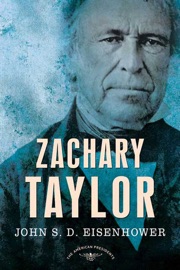
Zachary Taylor
By John S. D. Eisenhower, Arthur M. Schlesinger, Jr. & Sean Wilentz
- Release Date: 2008-05-27
- Genre: Biographies & Memoirs
Description
The rough-hewn general who rose to the nation's highest office, and whose presidency witnessed the first political skirmishes that would lead to the Civil War
Zachary Taylor was a soldier's soldier, a man who lived up to his nickname, "Old Rough and Ready." Having risen through the ranks of the U.S. Army, he achieved his greatest success in the Mexican War, propelling him to the nation's highest office in the election of 1848. He was the first man to have been elected president without having held a lower political office.
John S. D. Eisenhower, the son of another soldier-president, shows how Taylor rose to the presidency, where he confronted the most contentious political issue of his age: slavery. The political storm reached a crescendo in 1849, when California, newly populated after the Gold Rush, applied for statehood with an anti- slavery constitution, an event that upset the delicate balance of slave and free states and pushed both sides to the brink. As the acrimonious debate intensified, Taylor stood his ground in favor of California's admission—despite being a slaveholder himself—but in July 1850 he unexpectedly took ill, and within a week he was dead. His truncated presidency had exposed the fateful rift that would soon tear the country apart.
Reviews
Zachary Taylor
3By Old Rough and ReadyFactually correct overall, somewhat understates James K Polks roll as preceding president and fails to tie the role of his one term in office as to how Taylor is even considered as a presidential candidate. I also believe he fails to show how this Polk abstention allows the Whig party to win the election of 48. In other words he fails to maintain the continuity of the political transition. I also feel he is philosophically opposed to Polks position in the Mexican American war as well as the acquisition of California and the Oregon territory. I think the author is guilty of looking at manifest destiny through modern eyes.
More by John S. D. Eisenhower, Arthur M. Schlesinger, Jr. & Sean Wilentz

Battles of the Revolutionary War, 1775-1781
William J. Wood, W. J. Wood & John S. D. Eisenhower
World War II in the Mediterranean, 1942-1945
Carlo D'Este & John S. D. Eisenhower
Teddy Roosevelt and Leonard Wood
John S. D. Eisenhower
Soldiers and Statesmen
John S. D. Eisenhower
They Fought at Anzio
John S. D. Eisenhower